Showing posts with label Musical Analysis. Show all posts

Thursday, April 23, 2020

Premiere of Beethoven's Fifth and Sixth Symphonies


The Premiere of Ludwig van Beethoven's Fifth and Sixth Symphonies 22nd December 1808 Venue: Theater an der Wien Beethoven is a genius par excellence .. a composer who broke the barriers shattering the classical period shackles and ushering the Romantic age in music [Who would have started a symphony with those two earth splitting E flat Major chords for his Third - The Eroica?]. On this day, was he a smart concert planner? Difficult to answer this question. I would have given my right arm to be in that concert and that premiere. As providence would have it, I can imagine the frustration of the Maestro when he found, apart from his deafness, a cold and bored audience in that concert hall in response to two of the greatest symphonies of the Romantic Period. The concert began at 1830 hours and with a break was to last for about four hours. Beethoven was trying the patience of those attending. He crammed the program in this fashion as this was the first major concert solely covering his works in almost six years. Emanuel Schikanaeder was that aristocrat who sponsored this concert. The program was to begin with Pastoral Symphony in F Major followed by Ah! Perfido for voice and orchestra; then Gloria from his Mass in C Major; this was then followed by Piano Concerto No. 4 in G Major. Beethoven was the soloist and conductor. Welcome break after that. The other side of the interval had Symphony No. 5 in C Minor and the program concluded with the Credo from the same Mass and Choral Fantasy for piano, choir and orchestra. He was a superhuman but the people in the audience were obviously not. The whole concert was a disaster and the orchestra players may have been grinding their teeth after it was all over. An important factor that some people ignore besides such a taxing concert program schedule was that there was no dedicated concert hall in Vienna in 1808. This meant that concerts were to take place in theatres when their normal business took a break during Lent and Advent periods. Another unfortunate thing that happened for Beethoven was that people were more interested in attending the performance of Haydn's Il Ritornio di Tobia Oratorio at the Burgtheater as it was to take place on that same day. So, the concert was over by 2230 hours. I would have loved it and would have been swooning by the end of it! The sad slice of irony is that Beethoven's divine output went on ears in the same way as it would have been when casting pearls before swine!

Wednesday, February 21, 2018

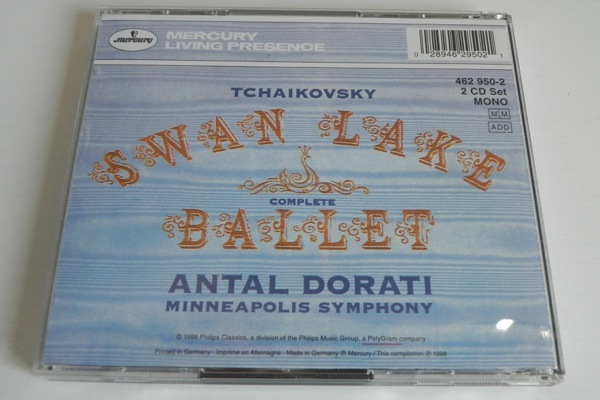
Le Lac des Cygnes - Swan Lake - The Original Score


Le Lac des Cygnes Swan Lake Piotr Tchaikovsky Antal Dorati Minneapolis Symphony
It does not happen on many occasions that an original score of a well known musical opus remains obscure to the world. It has happened in the case of the original score for Tchaikovsky’s Swan Lake ballet. Today, Swan Lake has come to be recognised as the queen of all traditional ballets, no one realises the tumultuous time it had during its earlier years, forcing the composer to keep, revising it neurotically. It all began in 1875, when the director of the Bolshoi Theatre in Moscow, V. Begitchev, commissioned Tchaikovsky to write a score for a ballet and the libretto was provided by the director himself in collaboration with Vasily Geltzer. The story is actually inspired by a German fairy tale and it got Tchaikovsky attracted to it. Tchaikovsky composed feverishly, giving an almost symphonic stature to the score for the ballet and when it was finished, the entire staff of the Bolshoi Theatre felt that it was too orchestral and difficult to perform. The first performance took place on 4th March 1877 and it turned out to be a dismal affair; even the audience not showing too much enthusiasm. The production did not include tasteful and imaginative choreography to match this kind of a symphonic score. The management of the Bolshoi Theatre then decided to tell Tchaikovsky that some sections of the score for the ballet were not danceable at all. They wanted to interpolate dances from other ballets in a similar fashion to how some productions in the earlier part of this decade have inserted Tchaikovsky’ First Winter Dreams Symphony into a ballet arrangement for Snegurochka or the Snow Maiden. So, Tchaikovsky’s original score for Swan Lake collected dust till 1883 and a performance was given at the Maryinsky Theatre at St. Petersburg with revisions and deletions edited by the composer. Another performance also resulted in a disaster. Tchaikovsky never had the fortune of watching his great opus performed as he intended any time after that. The ballet was first appreciated in 1901 when Alexander Gorsky produced it for Bolshoi Theater and took up the challenge admirable, albeit eight years after the composer had long left his earthly abode at a young age of fifty three. He died of cholera. This performance gave the ballet its immortality. What we see choreographed today is the version stamped by the artistry of Marius Petipa and Lev Ivanov, whose partnership finally saved Swan Lake from extinction. Antal Dorati with Minneapolis Symphony and Mercury Recordings presented the first recorded score of this famous ballet. It deserved a world premiere merit at the time it came out in December 1954. The performance was recorded in the Northrop memorial Auditorium at the University of Minnesota with a single Telefunken microphone hanging fifteen feet above, slightly behind the head of Mr. Dorati. The orchestra was arranged in a normal concert performance set up to achieve a natural balance among the featured solo instruments and the orchestral ensembles. This recording can be considered as an important milestone in the disc literature of this ballet master work.

Saturday, January 14, 2017

The Great Bruckner Interpreters


In the history of recorded music of Anton Bruckner, various interpreters have shown their mutual affinity for him. Their conducting styles may have varied but the depth of their commitment was consistently sublime. Some conductors such as Wilhelm Furtwangler, Otto Klemperer and Karl Bohm were born before Bruckner's death. Klemperer, in his early days, was associated with another giant, Gustav Mahler who had met Bruckner and was influenced by the Master while developing his own distinct style. He gave that reverence to the medium of symphony as his highest form of expression. Karl Bohm was encouraged ten years after Mahler's death by Bruno Walter, a disciple and a Bruckner advocate. Wilhelm Furtwangler studied with Felix Mottl who was one of the composition pupils of Anton Bruckner. Another great Bruckner conductor, Jascha Horenstein collaborated with Furtwangler earlier in his career and prepared festival concerts. It is a well known fact that both Furtwangler and Klemperer had to face staggering challenges while continuing with their careers. The troubles were of a political nature in the case of Furtwangler while for Klemperer, there were a chain of physical mishaps and with little political influence also taking its toll. It had a negative impact in terms of health and his public image. Klemperer had an iron will and he was determined to survive through numerous afflictions. Everything was going against him and yet, he triumphed. These are my Bruckner conductors in order of preference - Sergiu Celibidache, Wilhelm Furtwangler, Otto Klemperer, Eugen Jochum, Lovro von Matacic, Volkmar Andreae, Hermann Abendroth, Gunter Wand, Franz Konwitschny, Yevgeny Mravinsky, Gennady Rozhdestvensky, Georg Solti, Leonard Bernstein, Herbert von Karajan, Sir Colin Davis, Bernard Haitink, Zubin Mehta, Takashi Asahina, Wolfgang Sawallisch, Daniel Barenboim, Jascha Horenstein, Karl Bohm, Stanislaw Skrowaczewski, Carlo Maria Giulini and Christoph Eschenbach.

Thursday, January 12, 2017

Des Knaben Wunderhorn


Des Knaben Wunderhorn is a set of twelve songs written for a baritone, a soprano and orchestra by Mahler. They were completed in 1905. These old German folk songs narrate about a boy's magic horn. These were folk poems from Germany that were edited by Von Arnim and Clemens Brentano. The anthology included poems on songs made by wandering soldiers and they were mostly about love and innocence. They became a strong part of Romantic nationalism in literature. Goethe recommended that this set of poems be part of every household in Germany. Mahler gave these lieder a dual setting. He composed nine of them for piano and voice and twelve songs for voice and orchestra. The songs are - "Der Schildwache Nachtlied" – The Sentinel's Night Song "Verlor'ne Müh" – Labour Lost "Trost im Unglück" – Solace in Misfortune "Wer hat dies Liedlein erdacht?" – Who Thought up this Song? "Das irdische Leben" – The Earthly Life "Des Antonius von Padua Fischpredigt" – St. Anthony of Padua's Sermon to the Fish "Rheinlegendchen" – Little Rhine Legend "Lied des Verfolgten im Turm" – Song of the Persecuted in the Tower "Wo die schönen Trompeten blasen" – Where the Fair Trumpets Sound "Lob des hohen Verstandes" – Praise of Lofty Intellect "Urlicht" – Primeval Light "Es sungen drei Engel" – Three Angels sang a Sweet Air The ideals of German national romanticism held that whatever was not corrupted by the ill effects of modern civilisation was instrumental in the nation's recovery and not many people are aware of the fact that the Brothers Grimm started their collection of German fairy tales under the inspiration and guidance of Clemens Brentano. From this collection of songs, Urlicht was incorporated into the Resurrection Symphony in 1894 as its fourth movement. Es Sungen Drei Engel found its place in the Third Symphony and was written for boys' chorus besides an alto singer. Des Antonius von Padua Fischpredigt also is found as the germ of the Scherzo in the Resurrection. while Absolung im Sommer is also adopted in the scherzo of the Third Symphony. Das Himmlische Leben was re-orchestrated and became part of the Fourth Symphony's finale. It was removed from the Wundehorn collection of songs at a later time. Here is a performance of these songs by Cleveland Orchestra under Pierre Boulez. https://youtu.be/zjd_czhHra0

Saturday, January 7, 2017

L'Enfance du Christ - Hector Berlioz


This oratorio was not planned by Berlioz initially as one opus. It was conceived by accident and developed one piece at a time over a longer time period. The Flight from Egypt was written initially in 1850. Berlioz related the circumstances in which he wrote it in his 'Les Grotesques de la Musique. The Arrival at Sais was composed in 1853. The Song of Herod was composed in the early part of 1854. The Holy Family at Rest was written in 1853 and this piece's success motivated Berlioz to complete and enlarge the composition. He finally felt that he caught the right essence of this Biblical work. L'Enfance du Christ was given its premiere in Paris in December 1854 and was received successfully. This was a big change for him because his La Damnation de Faust was not so well received here eight years earlier in 1846. Berlioz was mostly drawing on his past memories while composing this oratorio. The memory that influenced him was his initial communion at La Cote Saint Andre. His teacher, Lesueur, introduced numerous oratorios to Berlioz on biblical subjects. The Nocturnal March makes up the first scene of this work and is orchestrated in a unique way. It is scored delicately for smaller ensemble. The setting depicts a Jerusalem street at night time. The march represents the patrolling of Roman soldiers. This piece forms an ideal setting for the scenes that have to follow, particularly the aria of Herod, his approach with the soothsayers and his edict of carrying out the massacre of all new born children. The Dance of the Soothsayers is also a short piece. This is Berlioz's most original pieces with a macabre and satanic impact. There are fluctuations in the tonal effect and the metre also alternates between quadruple and triple time. It has its influence from Gluck and Carl Maria von Weber. The Flight to Egypt is scored for a modest ensemble like the remainder of the work and it is quite subdued when it comes to tonality. The main theme of this Flight is taken from the Nocturnal March earlier from the work. The trio for a couple of flutes and harp depicts an Ishmaelite father who welcomes Mary and Joseph into his home and he gets his children to perform this trio to calm his guests down. It is one of the scanty instrumental pieces written by Berlioz to make up this work. https://www.youtube.com/watch?v=JpiNciwKGcY Orchestre de la Société des Concerts du Conservatoire 1965/1966 André Cluytens, conductor

Friday, December 30, 2016

Sibelius - Sixth Symphony in D Minor


This is the first ever recorded version of this symphony Finnish National Orchestra directed by Georg Schneevoigt in 1934 https://youtu.be/wwugUjZUs2U Sibelius wrote on his Sixth Symphony: "Whereas most other modern composers are engaged in manufacturing cocktails of every hue and description, I offer the public pure cold water". Benjamin Britten also commented, "He must have been drunk when he wrote it." There is an irony when Sibelius describes his sixth symphony. It cannot be ignored that he had a predilection for liquor. There is no doubt that Sibelius has used strange kind of polyphony in his writing but this definitely ads to its distinct flavour. The whole symphony has to be played in the mezzo forte range and it cannot be too loud or too soft. Whatever the case may be, this is indeed a strange symphony coming out of the year 1923. It is a work that takes you back to an age before tonality and it uses strange modes and scales that can be termed ambiguous. The symphony involves heavy tension between C Major scale and D minor that has an inflected mode. It ends without an emphatic statement and this is what makes this symphony unique. Lorin Maazel with Vienna and Karajan with Berlin Philharmonic have brought this symphony out very well but my personal favourite is the performance by Philharmonia Orchestra under Vladimir Ashkenazy. This could be described as music that may be self-effacing. The symphony intentionally does not leave any mark; it is like going or a walk in the snow and trying to cover up your tracks. Music critics have observed that Sibelius wrote this symphony without using markers of time and he left the musical imagination wide open. The rhythm is suspended while the strings play and in the flow of play by woodwinds. The rhythm is actually picked up and energised by repeated rhythm in the harp. In the second movement too, there is a strange layer of different kinds of time being kept. The scherzo generates some structural expectations. The finale picks up ferocious speed before subsiding in an uneasy calm in the final bars.

Tuesday, March 29, 2016

Violin Concerto of Beethoven in D Major


https://youtu.be/f8yZu9tSX7E Ludwig van Beethoven composed his D Major Violin Concerto in 1806. It was published as Opus 61. He wrote it with his violinist friend, Franz Clement, in mind. Clement gave its premiere performance on 23rd December 1806 in the Theater An Der Wien as part of a benefit concert for himself. It was a failure as, surprisingly, the audience was not so interested in it. Part of the failure was attributed to the fact that Beethoven finished writing the solo part very late and Clement had to do sight reading for most of his performance. Also, Clement interrupted the concerto between the first and the second movement with a solo composition of his own which he played on just one string of the violin, holding it upside down. I would venture to guess that it was the first violin concerto that could be deemed as solemnly serious and demanding of spiritual attention and the mass was not ready for it. I feel that they may have been flummoxed by the length and the breadth of the movements with their serious messages. This great violin concerto was pushed into obscurity during Beethoven’s lifetime and it was only revived in 1844 by Joseph Joachim who played it under Mendelssohn with the London Philharmonic. It was finally accepted and since then, it has remained as one of the widely performed in the violin repertoire. Prior to 1806, Beethoven had written numerous compositions for violin and orchestra. He had written two Romances for violin and orchestra in F Major and G Major. In 1792, he even contemplated writing a concerto for violin in C Major. A fragment of its first movement had survived but lost after his death in 1827. It was never completed nor published. Many musical critics have explained that the opening of the first movement in martial style with the timpani beat was an influence of the French style at that time, exemplified by Pierre Rode. The broken sixth and the broken octaves that follow the timpani beats are representative of the style of music written by Kreutzer and Giovanni Viotti. As a result of the failure of the concerto during its initial performance, Muzio Clementi advised Beethoven to revise the concerto and produce a version for pianoforte and orchestra and the result was the Opus 61A creation. The concerto is made up of three movements – Allegro ma non troppo in D Major > Larghetto in G Major > Rondo/Allegro in D Major. It is scored for a solo violin, flute, two oboes, two clarinets, two bassoons, two horns, two trumpets, strings and timpani. Besides Beethoven’s cadenzas for the first and the third movements, other violinists who have written their own cadenzas are Joseph Joachim and Fritz Kreisler. Alfred Schnittke has written cadenzas with a modern flavour. The format of the first movement is one of the greatest examples that could be given of the sonata structure during Beethoven’s creative second period. You have to be aware of the fact that the length of this movement is as long as the full concertos or symphonies of Haydn and Mozart. Beethoven articulates every theme and gives it a distinct character. The importance of every theme could be grasped as soon as it is presented. He develops the movement material from a simple six-motif combination of A, B, C, D, E and F. He has created one of the most sublime compositions with this movement in the history of concerto music. You can say that this movement is a fine example of how to achieve an ideal equilibrium in compositions.