Showing posts with label Music Reviews. Show all posts

Friday, May 15, 2026

What is a Theremin?

People who are interested in the sounds of diverse instruments for music should be interested in this term. This is a quantum instrument which is played mainly by the energy that is generated from our hands. This instrument creates a magnetic field which could be created without any touch and it gives out a sound that resembles the human voice. The person playing this instrument would have to stand in front of the instrument and move his or her hands around two metal antennae. The distance from one antenna will establish the frequency or pitch while the distance from the other antenna will control the amplitude or the volume of sound. The Theremin will use the heterodyne principle to generate audio signals. It may sound too easy but it is not. The instrument is quite difficult to master. This instrument was invented by a Russian, Leon Theremin, in 1920. It was presented first to Vladimir Lenin, who was very impressed with its sound. Lenin ordered a quantity of six hundred instruments to be produced for him. Lenin arranged for a voyage that Theremin had to undertake for the sole purpose of introducing this unique instrument to many places in the world. The instrument was given its due attention by three out of close to two hundred countries – only Russia, Japan and Ireland. You can consider a Theremin to be the first electronic musical instrument in the world which is played without any physical contact. The Thereminist will control the pitch and volume by moving hands near the two metal antennae that helps to create electromagnetic fields. This gives out ethereal and haunting tones that resemble a human voice. The operating mechanism is on the principle of variable capacitance which uses vacuum tubes or solid-state electronics to create electromagnetic fields. This instrument has been heard mainly in film background scores such as `Spellbound’ and `The Day the Earth Stood Still’. It is not an easy instrument to play as it demands precise hand positioning, without physical keys or frets. The Beach Boys also used this instrument in their rock compositions. Take a look, here:- https://www.youtube.com/shorts/Gz_UhVyF0Ao?feature=share

Friday, November 28, 2025

The Definitive Ring of Wagner by Solti

For his Musik Drama, Richard Wagner had made it clear with his directives that more important than the singing was the acting and the orchestra accompaniment component. Wagner was concerned entirely with the outline of his musical leitmotifs that are woven in the fabric of this music drama. An Introduction to the Ring, the beautiful white box set presented by Derryck Cooke, still stays in my mind as the ideal introduction set for anyone visiting the Nibelungen Ring Drama for the first time. Cooke collaborated with Georg Solti and the Vienna Philharmonic. These recordings were engineered by Mr. John Culshaw between 1958 and 1965. Das Rheingold has to be one of the most famous of Solti's recordings. I have heard many Rheingolds in the past thirty eight years from Masters like Furtwangler, Keilberth, Karajan, Boulez and Maazel. They do not come even close to Solti. Solti and Decca have created a miracle. The `Gramophone' magazine has voted it in 1997 as the greatest opera recording ever made. I will agree with it. An extract of a review of Siegfried’s performance by Solti and Vienna Philharmonic: Reviews of the 1962 Solti’s Siegfried recording with the Vienna Philharmonic are positively overwhelming, praising the recording as a landmark achievement in sound and musical interpretation. Critics highlighted the exceptional playing of the Vienna Philharmonic, the stellar cast led by Wolfgang Windgassen as Siegfried and Georg Solti's conducting as magnificent and powerful. The recording was described as revolutionary for its time, considered by many to be the greatest recording of Siegfried and a pinnacle of the Solti Ring Cycle. Orchestral performance: The Vienna Philharmonic's playing was described as exceptional and magisterial. Singing: The cast was considered unbeatable with Wolfgang Windgassen's Siegfried praised for being both lyrical and heroic. Hans Hotter was considered more impressive than ever on this recording and Joan Sutherland and Birgit Nilsson were singled out as having legendary interpretations of their roles. Solti's conducting was hailed as powerful and magnificent.

Monday, June 12, 2023

Music Experience at St. Florian Monastery

Introduction: Nestled in the serene countryside near Linz, Austria, Stift St. Florian Monastery stands as a testament to architectural grandeur and a haven for divine music. Besides its rich history and stunning Baroque architecture, the monastery holds a secret that captivates visitors from around the world—the extraordinary acoustics within its hallowed halls. This article explores how the acoustics at Stift St. Florian Monastery are received by the audience, creating an awe-inspiring auditory experience. A Sonic Marvel: Upon entering the monastery's Abbey Church, visitors are greeted by a symphony of harmonious echoes and resonating melodies. The vast, cavernous interior with its high vaulted ceilings and ornate decorations creates an acoustic environment unlike any other. The sound within the church reverberates and carries, enveloping the audience in a sublime auditory embrace. Choral Performances: The acoustics of Stift St. Florian Monastery are particularly renowned for enhancing choral performances. As the heavenly voices of the choir fill the space, every note reverberates and blends harmoniously, allowing the melodies to soar effortlessly. The acoustic design ensures that even the softest whispers of the singers can be heard with clarity throughout the church, making every nuance and expression palpable to the listeners. Instrumental Concerts: Beyond choral performances, Stift St. Florian Monastery's acoustics also elevate instrumental concerts to unparalleled heights. The rich tones of string instruments, the crisp clarity of woodwinds, and the majestic resonance of organs are all enhanced by the cathedral-like space. Each note lingers, creating a captivating auditory trail that amplifies the emotional impact of the music. Audience Experience: Visitors to Stift St. Florian Monastery often describe the acoustic experience as transformative. The combination of the majestic architecture, sacred atmosphere, and exceptional acoustics creates an immersive sensory journey. Listeners report being deeply moved, their spirits lifted, and their souls touched by the profound musical performances within the monastery's walls. Preserving the Sonic Legacy: The captivating acoustics of Stift St. Florian Monastery are not a happy accident but the result of careful architectural planning and design. The structure's geometric proportions and the materials used such as marble and stone contribute to the sound reflections and reverberations. Efforts are made to preserve this sonic legacy by maintaining the monastery's infrastructure, ensuring that future generations can continue to enjoy the divine auditory experiences that have captivated audiences for centuries. Conclusion: Stift St. Florian Monastery near Linz, Austria, is not only a magnificent architectural gem but also a sanctuary for mesmerising acoustics. The resplendent space reverberates with the sound of choral performances and instrumental concerts, leaving audiences spellbound. The sonic legacy of Stift St. Florian Monastery continues to thrive, immersing visitors in an auditory journey that transcends time, connecting the divine power of music with the hearts of all who listen. I have been fortunate to visit the Abbey and attend a concert at the Monastery Cathedral. Bruckner Linz orchestra played Sven-Erik Werner’s Homage a Bruckner and Bruckner’s Seventh Symphony in E Major with Markus Poschner conducting. The experience was a splendid one.

Wednesday, February 21, 2018

Le Lac des Cygnes - Swan Lake - The Original Score
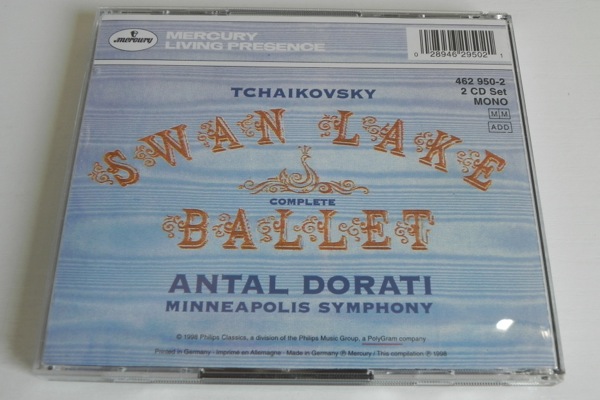

Le Lac des Cygnes Swan Lake Piotr Tchaikovsky Antal Dorati Minneapolis Symphony
It does not happen on many occasions that an original score of a well known musical opus remains obscure to the world. It has happened in the case of the original score for Tchaikovsky’s Swan Lake ballet. Today, Swan Lake has come to be recognised as the queen of all traditional ballets, no one realises the tumultuous time it had during its earlier years, forcing the composer to keep, revising it neurotically. It all began in 1875, when the director of the Bolshoi Theatre in Moscow, V. Begitchev, commissioned Tchaikovsky to write a score for a ballet and the libretto was provided by the director himself in collaboration with Vasily Geltzer. The story is actually inspired by a German fairy tale and it got Tchaikovsky attracted to it. Tchaikovsky composed feverishly, giving an almost symphonic stature to the score for the ballet and when it was finished, the entire staff of the Bolshoi Theatre felt that it was too orchestral and difficult to perform. The first performance took place on 4th March 1877 and it turned out to be a dismal affair; even the audience not showing too much enthusiasm. The production did not include tasteful and imaginative choreography to match this kind of a symphonic score. The management of the Bolshoi Theatre then decided to tell Tchaikovsky that some sections of the score for the ballet were not danceable at all. They wanted to interpolate dances from other ballets in a similar fashion to how some productions in the earlier part of this decade have inserted Tchaikovsky’ First Winter Dreams Symphony into a ballet arrangement for Snegurochka or the Snow Maiden. So, Tchaikovsky’s original score for Swan Lake collected dust till 1883 and a performance was given at the Maryinsky Theatre at St. Petersburg with revisions and deletions edited by the composer. Another performance also resulted in a disaster. Tchaikovsky never had the fortune of watching his great opus performed as he intended any time after that. The ballet was first appreciated in 1901 when Alexander Gorsky produced it for Bolshoi Theater and took up the challenge admirable, albeit eight years after the composer had long left his earthly abode at a young age of fifty three. He died of cholera. This performance gave the ballet its immortality. What we see choreographed today is the version stamped by the artistry of Marius Petipa and Lev Ivanov, whose partnership finally saved Swan Lake from extinction. Antal Dorati with Minneapolis Symphony and Mercury Recordings presented the first recorded score of this famous ballet. It deserved a world premiere merit at the time it came out in December 1954. The performance was recorded in the Northrop memorial Auditorium at the University of Minnesota with a single Telefunken microphone hanging fifteen feet above, slightly behind the head of Mr. Dorati. The orchestra was arranged in a normal concert performance set up to achieve a natural balance among the featured solo instruments and the orchestral ensembles. This recording can be considered as an important milestone in the disc literature of this ballet master work.

Tuesday, April 26, 2016

Beethoven's Razumovsky String Quartet No. 7. Op. 59 in F Major


https://youtu.be/oXLKu-HglnM This string quartet is the first among three quartets that were commissioned by Count Andrei Razumovsky who was then the Russian Ambassador to Vienna in 1806. This quartet falls also among the first of Beethoven's middle period quartets. Thise set of quartets is much different from his earlier group of Opus 18 quartets. These are longer in duration than the earlier ones and they involve a technical repertoire which is quite expanded. The first movement is in an expansive sonata form. It includes a fugato in its development section. The lengthy development section reminds you of the expanse of the first movement of the Eroica Symphony. Eroica was composed a few years earlier and it is considered as the beginning of Beethoven's middle period works.There is a delayed entry of recapitulation. It happens after the tonic key gets established and it generates an expectation of a definite statement. The opening melody on the cello is ambiguous tonally and its first cadence is established in the key of F Major a little into few bars of the movement.The extended coda section is also very nicely crafted. The second scherzo movement is quite unusual among the middle period works of Beethoven. It is also in sonata form like the solemn slow third movement and the fourth movement which is built on a Russian theme. It was an attempt to make the work familiar to the Russian ambassador. It has a cheerful melody which appears in the beginning and it is based on a folk song. There is both canonic and contrapuntal activity here. It has a development section and a recapitulation of a genial nature. On the final leaf of his sketches for the quartet, Beethoven mentioned a phrase, "A weeping willow or acacia tree on my brother's grave." It is interesting to note that both his brothers were alive when this work was composed; so, the interpretation is that this phrase has a masonic significance as the acacia is considered to be the symbolic plant in Freemasonry. This work is considered among the finest chamber works of the classical period. This set of three quartets is generally found to be difficult to perform. They were written in a span of six months.

Sunday, April 24, 2016

Verdi Otello Karajan


https://youtu.be/L45YKMxOFjA This was an opera written by Verdi in his last years. It is his penultimate opera. The libretto for this opera was written by Arrigo Boito who is famous for his opera Mefistofele. He also worked on several other libretti for other composers. It is a mighty good effort and even Shakespeare would be proud of this opera. The cast, the sets and the orchestra along with its conducting are all excellent. Otello is played by Jon Vickers who delivers with a booming voice. It is well matched for this part. He is a fine actor, too. Mirella Freni plays Desdemona and sings flawlessly. She is also a fine actress. Peter Glossop plays Iago. The sets of this opera are highly effective. The opera was shot partially in Venice and the setting is in a medieval castle that has brilliant murals. You will come across some stunning and lavish sets in this particular production. Karajan does a Hitchcock in the tavern scene in the first act. Karajan has directed this film and conducted the Berlin Philharmonic and the singers in this production. I have never heard any other orchestra play Otello with such aplomb and in these forty one years, I do not think such orchestral playing for this opera has been surpassed. It is simply an outstanding performance. https://youtu.be/n8lM8SjB6eY

Saturday, April 2, 2016

Tchaikovsky Fate Karajan Philharmonia 1954


When the fourth symphony of Tchaikovsky was initially performed in 1878, many among the audience raised a question on whether it was purely a symphony or a symphonic poem. This question then started echoing through the concert halls in Europe. Tchaikovsky had proclaimed the opening motif in this symphony as `fatum' and he made it asthe fate theme. The symphony then went on to become a hot battle ground for the use of a title. I, however, call it FATE as there is a symphonic poem also composed by Tchaikovsky with the title of FATUM. People fail to realise that Tchaikovsky used to suffer with nervous disorder in different forms and these depression bouts were strongest during the time that he was composing this symphony. He was going through nervous strains and all thse are reflected in this music. He was also trying to recover from a marriage that proved disastrous for him. It resulted almost in a mental breakdown. He recuperated by retreating to Lake Geneva and to Italy. He was able to work peacefully on the symphony as a result of the financial support from Nadejda von Meck, his benefactress. She remained his admire and correspondent. They never met during his lifetime as per terms of the agreement they had made with each other. Tchaikovsky referred to the opening motif as `Fate' and acknowledged openly that he was inspired by Bethoven's Fifth Symphony. In Beethoven's symphony, fate is a participant whereas in this symphony, fate is only an onlooker. The opening motif gives way to the first waltz subject; it has a depressive mood. The despair builds up in intensity. Comfort is found in the second subject on the clarinets, accompanied by a counterpoint in the cellos. At the climax, fate intervenes again as the coda is full of despair. The second movement is a lesson in melancholia. You may feel that it is an old person remembering his youthful days. The first andantino theme is given by the oboe and the second theme is given by the strings in low-pitched octaves. The scherzo is unique in all the symphonic repertoire as it is a marvellous exhibition of lightness, marked by pizzicatos on the strings. It highlights the fantasy of an intoxicated mood. The middle section has an unusual structure with dissimilar halves; you have a rustic theme on the winds which is followed by brass playing staccato. The finale bursts on to the scene to drive away personal sorrows to experience happiness. It comes like a tornado and then gives way to a Russian folk tune, 'In the fields stood a birch tree'. This theme has also been used by Mily Balakirev in his `Overture on Russian Themes'. Fate appears for the last time before the symphony concludes on a majestic note. This symphony is an exercise in master orchestration. People talk bullshit about aesthetics and ask various questions about whether it is a symphony; the answer to them is a YES. It is a symphony with effective orchestration and ornamental details. This 1954 performance by Karajan and the Philharmonia Orchestra of London is a fine document of this great symphony.

Tuesday, March 29, 2016

Violin Concerto of Beethoven in D Major


https://youtu.be/f8yZu9tSX7E Ludwig van Beethoven composed his D Major Violin Concerto in 1806. It was published as Opus 61. He wrote it with his violinist friend, Franz Clement, in mind. Clement gave its premiere performance on 23rd December 1806 in the Theater An Der Wien as part of a benefit concert for himself. It was a failure as, surprisingly, the audience was not so interested in it. Part of the failure was attributed to the fact that Beethoven finished writing the solo part very late and Clement had to do sight reading for most of his performance. Also, Clement interrupted the concerto between the first and the second movement with a solo composition of his own which he played on just one string of the violin, holding it upside down. I would venture to guess that it was the first violin concerto that could be deemed as solemnly serious and demanding of spiritual attention and the mass was not ready for it. I feel that they may have been flummoxed by the length and the breadth of the movements with their serious messages. This great violin concerto was pushed into obscurity during Beethoven’s lifetime and it was only revived in 1844 by Joseph Joachim who played it under Mendelssohn with the London Philharmonic. It was finally accepted and since then, it has remained as one of the widely performed in the violin repertoire. Prior to 1806, Beethoven had written numerous compositions for violin and orchestra. He had written two Romances for violin and orchestra in F Major and G Major. In 1792, he even contemplated writing a concerto for violin in C Major. A fragment of its first movement had survived but lost after his death in 1827. It was never completed nor published. Many musical critics have explained that the opening of the first movement in martial style with the timpani beat was an influence of the French style at that time, exemplified by Pierre Rode. The broken sixth and the broken octaves that follow the timpani beats are representative of the style of music written by Kreutzer and Giovanni Viotti. As a result of the failure of the concerto during its initial performance, Muzio Clementi advised Beethoven to revise the concerto and produce a version for pianoforte and orchestra and the result was the Opus 61A creation. The concerto is made up of three movements – Allegro ma non troppo in D Major > Larghetto in G Major > Rondo/Allegro in D Major. It is scored for a solo violin, flute, two oboes, two clarinets, two bassoons, two horns, two trumpets, strings and timpani. Besides Beethoven’s cadenzas for the first and the third movements, other violinists who have written their own cadenzas are Joseph Joachim and Fritz Kreisler. Alfred Schnittke has written cadenzas with a modern flavour. The format of the first movement is one of the greatest examples that could be given of the sonata structure during Beethoven’s creative second period. You have to be aware of the fact that the length of this movement is as long as the full concertos or symphonies of Haydn and Mozart. Beethoven articulates every theme and gives it a distinct character. The importance of every theme could be grasped as soon as it is presented. He develops the movement material from a simple six-motif combination of A, B, C, D, E and F. He has created one of the most sublime compositions with this movement in the history of concerto music. You can say that this movement is a fine example of how to achieve an ideal equilibrium in compositions.

Tuesday, March 15, 2016

Beethoven Archduke Piano Trio No. 7 in B Flat Major


https://youtu.be/Nl8H9_7y7-g The Piano Trio in B-flat major, Op. 97, by Ludwig van Beethoven is a trio for piano, violin, and cello. It was composed in 1811.It belongs to Beethoven's middle period of creativity. It is called `Archduke' as it was dedicated to Archduke Rudolph of Austria, the youngest of twelve children of Leopold II, Holy Roman Emperor. Rudolf was an amateur pianist and a patron student of Beethoven. He has eceived a total of fourteen composition dedications from Beethoven. The work is in four movements: Allegro Moderato/ Scherzo (Allegro)/ Andante cantabile ma perĂ² con moto - Poco Piu Adagio/ Allegro Moderato – Presto.

Friday, March 11, 2016

My Favourite Swan Lake Performance


https://youtu.be/OQvISdUX9kE For Swan Lake, this was an ideal partnership and I have not seen a better performance of this ballet anywhere, ever since. Swan Lake remained a special ballet in the career of Rudolf Nureyev. He danced in the role of Prince Siegfried in 1963 with the Royal Ballet and that production was staged by Nicholas Sergeyev who was the former stage manager of the Maryinsky Theatre. Nureyev gave the role his own identity. He redefined this character by going against the boring and colourless interpretations. Thanks to Nureyev, the male dancer in this ballet now became the equal of the female star. Margot Fonteyn was his perfect match and he danced with her first in 1963 at the Champs Elysees Theatre in Paris.Nureyev has imposed not only is charisma and his skills throughout his career in numerous versions of Swan Lake but he has also danced on some occasions in the role of evil Rothbart, the sorcerer. My favourite performance is with the Vienna Opera dancers and Vienna Symphony Orchestra under the direction of John Lanchbery. Fonteyn and Nureyev created the original choreography of Le Lac Des Cygnes under the direction of Nureyev with costumes and decors done by Nicholas Georgiadis. This film was captured by Unitel in 1964 and the production became an artistic mega event. At the final performance of the premier in Vienna, Fonteyn and Nureyev received eighty nine curtain calls and this is the highest number that has ever been taken, anywhere.

Friday, December 25, 2015

Snegurochka


The Snow Maiden by Piotr Ilyich Tchaikovsky https://youtu.be/mQdNl64u_14 Russian State Orchestra and Chorus Andrei Christiakov The Snow Maiden is a figure in Russian folk tales. She is beautiful and has skin as white as snow, blue eyes and curly hair. She is known as ‘Snegurochka’ in Russian - ‘sneg’ is the Russian word for snow. She is the daughter of the immortal Gods, Father Frost and Mother Spring. The Snow Maiden first appeared in writing in the nineteenth century. The roots of this character can be found in Slavic pagan beliefs. The folk tale became even more popular in 1873 when it was converted into a play,‘The Snow Maiden’ for the Moscow Imperial Theatre. It was written by Aleksandr Ostrovsky, with music written by Tchaikovsky. The tale was also adapted into an opera by Nikolai Rimsky-Korsakov, ‘The Snow Maiden: A Spring Fairy Tale’, in 1881.

Berlioz La Mort de Cleopatre


https://youtu.be/Fv4ZIcVq-4U This is a cantata written by Hector Berlioz. It was inspired from a poem by P. Vieillard. This cantata is less familiar in the vocal music repertoire. For Berlioz's followers, it brings into focus Berlioz's admiration in the realm of antiquity. It also includes a melody that Berlioz would later use again in his opera `Benvenuto Cellini'; it is used as the English horn theme that can be heard at the beginning of the second section of Le Carnaval Romain. The composition is broken into five segments - 1. Allegro vivace con impeto - Recitativo 2. Lento Cantabile - Recitativo 3. Méditation. Largo Misterioso 4. Allegro Assai Agitato 5. Moderato. Recitativo Misurato Berlioz entered this composition in 1829 in the Prix de Rome. This was his third attempt at the coveted prize. In those days, the judges were known for their conservative inclinations and, as expected, even his third attempt was unsuccessful as he did not do anything about diluting his innovative and adventurous style of writing. However, Berlioz won after a couple of years when he submitted another cantata, `La Mort de Sardanaple'. Jessye Norman and Daniel Barenboim with L'Orchestre de Paris bring out a convincing performance and make a strong impression. I have this on DGG vinyl that I purchased in 1985. Norman has given a gripping portrayal of the tragic queen who died by her own hand. Norman is superb in the central Meditation and in the fashion she whispers the last phrases uttered by the Queen. It is a compelling performance. Barenboim matches her achievement by bringing out the innovative nuances of Berlioz's score, supporting her all the time. The final passages are superb with sthe strings illustrating the death of Cleopatra. These are extremely original passages and the judges were arseholes not to realise the astonishing and compelling style of writing.

Tuesday, December 22, 2015

Sibelius Fourth


https://youtu.be/zl_q1QDkiiw Sibelius composed his dark Fourth Symphony in A Minor in 1910. He wrote eight symphonies - seven numbered and one big symphonic poem Kullervo. He composed these symphonies between 1899 and 1924 and stopped writing symphonies after that. The movements of his Fourth Symphony are at variance with the symphonic traditions of the times, particularly the way the second and fourth movements culminate and die out in a whimper. Sibelius developed his symphonic style through the formative powers of his themes. He used melodies with a broad span and concise motifs with thematic germ cells. The music ranges between brightness and ominous darkness. The brevity in his composition style is aphoristic. The themes bring out Sibelius' inner thinking processes. The first movement opens with a dark chord and the cello introducing a three-part song. You will come across a thematically independent introduction as well as a coda. The second movement is also a three-part song that has an extensive closing section that introduces new themes. The third movement is an expansive one and it opens with a couple of short phrases that alternate in various forms and they reappear unchanged, giving the whole movement a sense of unity. The finale is written in sonata form but it does not have the standard recapitulation as a result of the change of the thematic material that is found in the development section. Sibelius assembles the motifs of the themes quite prominently in this symphony and they compete with each other, both singularly and in combination. You will come across this in the exposition of the first movement and again in parts of the finale. The cello carries the theme in the first movement while the violin carries it in the final movement. The texture of writing is mostly polyphonic, giving the sound a unique type of transparency. Sibelius favours darker tone colours, making the themes sound significant. Sibelius conducted the premier of this symphony in Helsinki in April, 1911. This symphony represents a deep, sombre and austere side of Sibelius' symphonic personality.

Monday, December 21, 2015

The Swan of Tuonela


https://youtu.be/HjyLWoJvtME Tuonela, as per Finnish mythology, refers to the land of the dead. The Swan of Tuonela glides on the dark waters of a lake there and it sings while it glides. This symphonic tone poem is taken from the series of poems Sibelius wrote for his `Legend’ in 1893. These poems were inspired by the Finnish national epic of `Kalevala’. This is part of the Lemminkainen Suite. Sibelius has combined two themes – one is the melody assigned to the swan which is played by the English horn or the Cor Anglais and another is a theme which is initially played by the cello and it is alter transcribed in the swan melody and developed further. Strings are also divided into several parts. They offer a vibrant background to the melody of the swan. The poem rises to a climax of pathos with a solemn reinstatement of the melody and sinking back to the atmosphere created at the opening.

Thursday, December 3, 2015

Fourth Symphony by Ives


https://youtu.be/-xXv55ARtsM The fourth symphony of Charles Ives was started by the composer in 1910 and completed by 1924. This symphony is recognized for its diverse layers of complexity as it requires two conductors for its performance. It involves large multi-layered orchestration. It combines elements and techniques that are innovative. It is one of the most important works of the twentieth century. It has been also hailed as Ives' climactic masterpiece. This symphony did not get its complete performance until Leopold Stokoswki conducted it with the American Symphony Orchestra at Carnegie Hall in New York City on 26th April, 1965, almost eleven years after the death of Charles Ives. It was also recorded on the Columbia Label.

Sunday, November 29, 2015

Storm Quintet of Beethoven


The `Storm' string quintet was composed in 1801. It is in C Major. It is actually a viola quintet as it is scored for the conventional string quartet with an additional viola (2 violins, 2 violas and a cello). It has four movements - Allegro moderato; Adagio molto espressivo; Scherzo; Allegro Presto. It is Beethoven with his simplicity of expressions; they unfold with effortless ease. The work is cheerful and confident sounding. It has a great lyrical flow and reminds you of the serene chamber works of Haydn and Mozart. The first violin has been given a soaring part in this quintet. The opening Allegro sets the mood of this work with its lyricism and ease of flow, making up two major themes. It has a shade of melnacholy in few places. The slow movement is melodic with a theme that is played over pizzicato. The flow is interrupted by expressions from minor keys. The scherzo is taken at a foot stomping pace and has a lyrical trio. The finale starts off with a tremolo that is utterly dramatic and it turns into a melody that rises to the violin's upper range of register. There is a fugal passage that extends across all the instruments to bring the composition to a close. It is a gem of a string quintet. https://youtu.be/8pgC6CX9oBA

Tuesday, June 30, 2015

Magic Fire 1955


https://youtu.be/uFCfRJ9_xL8 This is a biopic on the life of Richard Wagner, played admirably well by Alan Badel. It was made in 1955 by Republic Pictures. Herbert Yates was the studio chief then. It was directed by William Deieterle. For all Wagner enthusiasts, this is a fine film that makes good use of Wagner's music. The actual film music was arranged by Erich Wolfgang Korngold. The film was processed in Trucolor as the other collaboration of Dieterle and Korngold, a Midsummer Night's Dream. Many details and accounts of the life of Richard Wagner were portrayed accurately and some of the accounts were stretched out for dramatic purposes. One of the highest points of this film is the accurate presentation of the riot among the elite at the Opera House in Paris during the Second Act of Tannhauser in its revised version with the Bacchanale and inclusion of ballet. Wagner did not heed to the advice of introducing the ballet in the second act as per the demands of the rich patrons; he kept it instead in the very beginning of the First Act, right after the fabulous overture. The film also correctly brings out the patronage of King Ludwig II in Wagner's life, without going too much into the intricate details of the controversial personality of that king. You will come across lavish sets, brilliant costumes and a large cast that includes the beautiful Yvonne De Carlo as Minna Planer, Wagner's First wife.Rita Gam plays Cosima, Liszt's daughter and Wagner's second wife while Carlos Thompson supports well as Franz Liszt. There are few scenes inducted in the film showing Weimar. This is a prestigious film and serves as a great biographical document for Richard Wagner.

Friday, February 20, 2015

Scriabin Mysterium Nemtin


http://youtu.be/V4YSysUn-Bk Universe 00:41:46 II. Mankind 01:33:45 III. Transfiguration Alexei Lubimov, piano Thomas Trotter, organ Anna-Kristiina Kaappola, soprano Ernst Senff Chor St Peterburg Chamber Choir Deutsches Symphonie-Orchester Berlin Vladimir Ashkenazy Mystery surrounds Mysterium. It is a work that was left unfinished by Aleksandr Scriabin. He started working on this composition in 1903 but kept it incomplete until his death twelve years later. He wanted this work to be performed in a synesthetic concert stage which gave the sensation of smell, touch and hearing. He wanted the spectators to participate. The intention on the core sheet was to include a large orchestra, a mixed choir and a wind machine along with a projector that gave out visual effects. He also wanted dancers with rhythmic articulation. He also wanted incense to be burnt all around the performing enclosure. It was his intention that the work should be first performed in the Himalayan foothills in Tibet with the help of lights and mists to give substance to the architectural contour. At the time of Scriabin's death, seventy two pages were completed of this composition. Aleksandr Nemtin spent twenty eight years after the death of Scriabin to reform the sketches and convert it into a work than spanned almost here hours. It was recorded eventually. This is a great version by Ashkenazy and the Berlin orchestra.

Tuesday, February 17, 2015

Tannhauser


Richard Wagner was inspired by nature for Tannhauser as in the case of the Flying Dutchman. When Wagner visited Wartburg in April 1842, he spent many months near a mountain ridge which he called `Horselberg'. This is where he completed most of this opera. This work was originally labelled as 'Der Venusberg'. It was changed in 1845 to 'Tannhauser und der Saugerkrieg auf der Wartburg'. He revised the score a couple of years later and changed the finale among many other things that included the addition of Venus and the funeral procession for the departed Elisabeth instead of a mere announcement of her death and it came to be known as the Dresden edition. It was revised once again in March 1861 and it came to be considered as the Paris version. The difference between these versions is that the initial two scenes were expanded through a Bacchanale with a pantomime written on a large scale. It also called for a ballet in the second act. Walther's song was also added in the second act. The Paris version brought out a nice contrast between the chromatic and the diatonic. The use of incidental music and choruses is also unique in this opera. It is surprising to note that Tannhauser was performed for the first time in Bayreuth in 1891. This performance took place in July 1994 during he opera festival of the Bavarian State at the Munich national Theater. This is a modern staging of Wagner's opera. It is a deeply passionate performance by Zubin Mehta but it will fall in line after Sir Georg Solti's Paris version, Wilhelm Furtwangler and Sir Colin Davis' interpretations. Must have been exciting for the people who attended this Munich Opera Festival. http://youtu.be/Izyg-fhQ0E8

Monday, January 12, 2015

Tchaikovsky's Fate in F Minor


http://youtu.be/f8sSlPmVM78 Tchaikovsky's Symphony No. 4 in F minor, Op. 36, was composed in the spring of 1877. Tchaikovsky talked about a symphony he is writing on the subject of fate in his letters. The work was played first in Moscow in February 1878. The Symphony is scored for a piccolo, 2 flutes, 2 oboes, 2 clarinets (in A, B-flat), 2 bassoons + 4 horns (in F), 2 trumpets (in F), 3 trombones, tuba + 3 timpani + violins I, violins II, violas, cellos, and double basses. Tchaikovsky was financially backed by a wealthy widow, Nadezhda von Meck, who sent him a monthly stipend in return for his steady correspondence with her about his music. The two never met in person but many letters remain from their steady correspondence. Those letters offer an insight into the perspective on his compositions. Tchaikovsky wrote about this symphony, "Never yet has any of my orchestral works cost me so much labour, but I have never yet felt such love for any of my things.…Perhaps I’m mistaken, but it seems to me that this symphony is better than anything I have done so far. This kind of enthusiasm was a bit strange for Tchaikovsky. He generally expressed dissatisfaction with his works. In this case, he felt that he had exceeded even his own demanding standards. The symphony score bore a dedication “to my best friend,” a reference to Von Meck. She accepted the honour but only on grounds of anonymity. Tchaikovsky explained that the opening fanfare has to sound ominous like the opening motif of Beethoven's Fifth Symphony. The opening is sounded out by french horns and bassoons. The motif represents fate hanging over our heads like the sword of Damocles. The motif has to be suggestive of gloom that is all-consuming and it has to obscure all hints of happiness that tend to appear in the form of light melodies in triple time, suggestive of waltzes. In the second movement, Tchaikovsky presents a continued expression of melancholy that is felt when you are lonely at the end of a weary day. The third movement with its unique pizzicato dominance represents fleeting images that pass through a person's imagination when he is a bit flippant and whimsical and out of this emerges the finale with its positive energy. The energetic drive is broken with the dark theme from the opening movement as the motif reappears to let the listeners be reminded that fate cannot be conquered and its force cannot be crushed. The symphony concludes with letting the people know that among the gloom, you can look at the plight of others around you and take solace by accepting whatever life offers you and how to bear it. Yevgeny Mravinsky has given a magnificent performance with the Leningrad Symphony and it was issued as a vinyl record on Deutsche Grammophon. The energy of that performance in 1960 is still preserved and no conductor has surpassed the sheer vitality of this performance. The majestic brass and the discipline of the strings is the trademark of Leningrad and Mravinsky. This particular performance was recorded during the visit of Leningrad Philharmonic to London and the capture was done at Wembley Town Hall in London.